The Blue Square Problem: Art, History, and the Ethics of Knowing
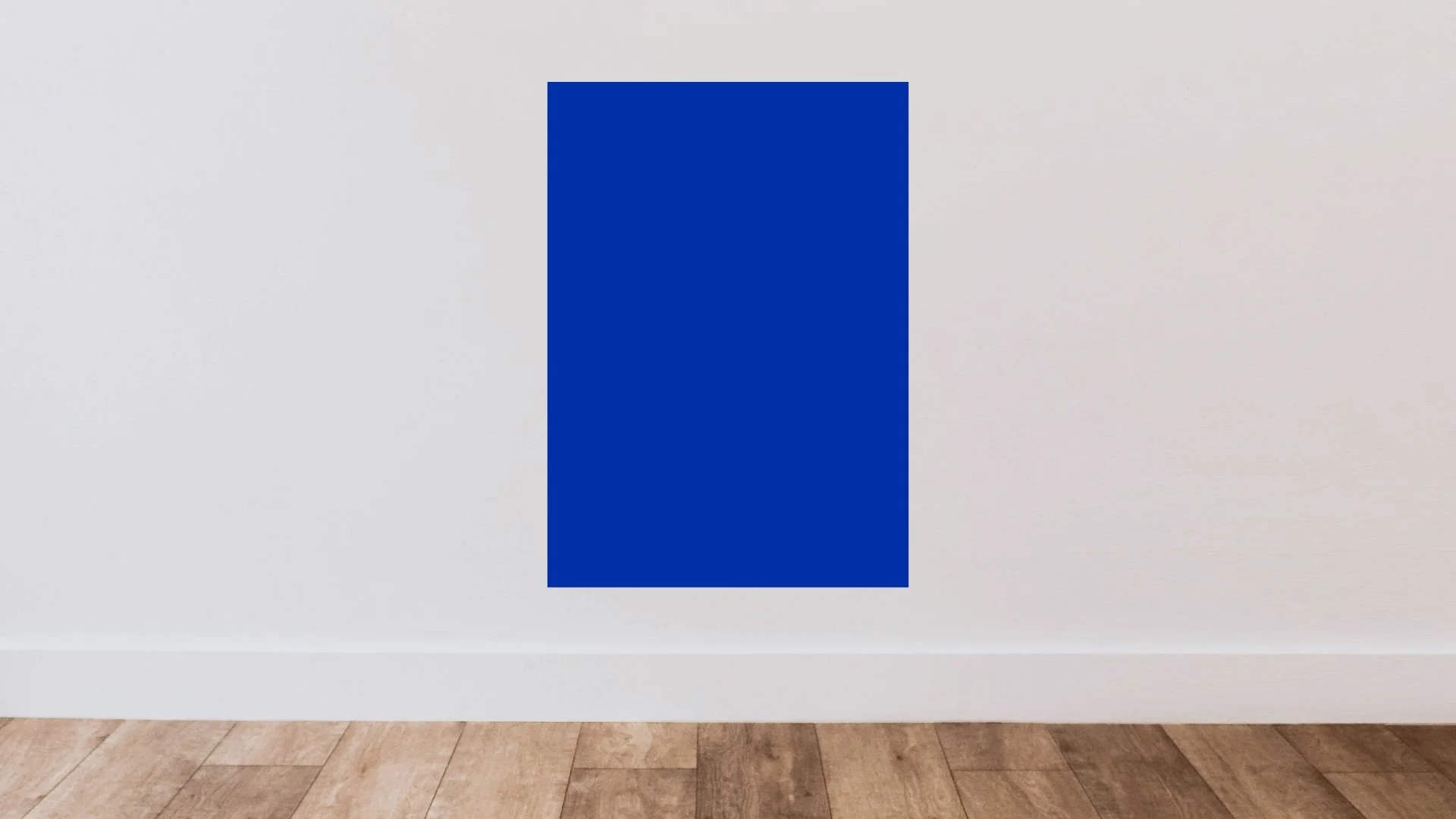
This is a digital reproduction of Yves Klein’s Blue Monochrome, not the original work itself.
Reading the comment section of posts will forever be my downfall. And yet, last week I lingered longer than usual, held captive by a post and its replies that have continued to echo in my thinking about art, history, appreciation, and accountability in the digital age. I did not rush to respond. I sat with it. I considered whether this was another instance where silence would be the more ethical choice—because not everything needs a response, and certainly not everyone needs to have an opinion on everything. But the longer I reflected, the clearer it became that what unsettled me was not trivial. It struck at the heart of my academic focus and my intellectual niche: the dynamic interconnection between ethics and wellbeing.
There should be an ethics to sharing things online—the operative word being should. Yes, this introduces an air of idealism, but striving toward better ethical practice is not naïve; it is a virtue worth cultivating. Not only for our own sake, but because the self mirrors society. Society cannot be well if individuals are not well, and individuals cannot flourish in a society that erodes shared standards of truth, care, and responsibility. A society cannot be educated if its members do not uphold the ethics of knowledge. And society cannot be well if the digital spaces we now inhabit are saturated with misinformation, rage bait, and smug dismissal masquerading as wit.
The incident itself was deceptively simple. A response video. A young woman walks past Yves Klein’s Blue Monochrome (1961), rolls her eyes, and exits the frame. The overlay text reads: I hate modern art. The video cuts to an art expert who, half-jokingly, asks, “Should we tell her?”—signaling that the work was misidentified. Klein’s piece is not Modern art but Contemporary. A technical correction, yes. But one that carries historical weight.*
The comment section, however, erupted with predictable refrains: Does it really matter? Did you really need to correct her? Is she not allowed to dislike art now? It’s not art. Without the context, it’s just a blue square.
I understand this reaction more than I wish to admit. I was never particularly fond of the “found object” turn in Dadaism myself. Even with the privilege of taking multiple art history courses during my undergraduate studies—learning the contexts, the ruptures, the philosophies—I was not suddenly converted. Knowing that Klein developed International Klein Blue, or that his monochromes were an attempt to confront the void, immateriality, and transcendence, does not guarantee emotional resonance. Art does not work that way, and it never has.
And yet, this is precisely where the conversation becomes more interesting and more fraught. Even the casual insistence on calling the work a “blue square,” when it is in fact a rectangle, reveals something subtle but consequential: the flattening of distinctions, where specificity is treated as expendable and precision as pretension. When form, history, and context are collapsed into shorthand, reality itself becomes negotiable. Comments like these could be dismissed as projection or defensiveness, but something deeper is happening—something about our collective relationship to knowledge, expertise, and accountability.
Art is both contextual and subjective. Not all art seeks to narrate an overt story, as medieval religious paintings once did. Some works, like Impressionist still lifes, are exercises in color theory and sensation—the emotional weight of light and pigment rather than the symbolic meaning of grapes or vessels. This raises an important question: can we appreciate something without liking it? I believe that capacity requires an extraordinary openness of mind. Appreciation does not demand personal identification or aesthetic pleasure; it demands recognition. And if one does not connect with a work, that is not a moral failure. They may not hang a Blue Monochrome in their home, just as I would not display Duchamp’s Fountain. Taste remains personal.
But dismissal of historical accuracy is where I pause.
I cannot treat viral social media posts as harmless or inconsequential when they reach millions. There are scholars, archivists, conservators, and historians who devote their lives to preserving cultural memory because history matters. Distinguishing between Modern and Contemporary art is not pedantry; it is a way of situating ideas in time, tracing how meaning evolves, and honoring intellectual labor. When accuracy is treated as optional, we begin to erode the scaffolding that allows shared understanding to exist at all.
This erosion does not occur in a vacuum. We are living amid rampant anti-intellectualism, chronic defunding of education, and a media ecosystem optimized for speed rather than depth. Short-form content trains us away from sustained attention and critical thought. Nuance becomes cumbersome. Context is treated as elitist. And expertise is flattened into “just another opinion.”
In this environment, thinking carefully before posting is not simply a personal virtue—it is a civic one. What we share shapes the epistemic climate we all inhabit. Personal accountability, then, requires a level of self-awareness and security that resists the dopamine hit of being loud in favor of the quieter work of being responsible.
Lately, I’ve noticed more experts responding publicly to misinformation, and this impulse is understandable—even necessary. But the manner of correction matters. Smugness met with smugness, or shame masked as comedy, transforms the privilege of education into perceived elitism. And elitism, real or imagined, rarely invites curiosity. More often, it hardens resistance and encourages people to double down.
Herein lies the ethical tension: how do we hold others accountable without reproducing the very harms we claim to oppose? How do we use education not as a cudgel, but as an invitation? If the goal is to preserve knowledge, expand understanding, and safeguard our shared epistemological foundations, then approach matters as much as accuracy.
In the end, this is not merely about a blue painting, or even about art at all. It is about how we choose to live together in a world increasingly mediated by screens—how we value truth, how we practice humility, and how we wield knowledge. Ethics and wellbeing are inseparable here: a society that treats correction as attack and expertise as arrogance cannot flourish, just as individuals cannot thrive without intellectual honesty and care for others. Accountability, when rooted in generosity rather than derision, becomes an act of stewardship. And perhaps that is the challenge of our moment—not to know more loudly, but to know more responsibly, remembering that how we teach, correct, and engage is itself a reflection of the world we are trying to build.
*Artistic movements are not sealed categories, but porous, transitional formations that overlap and bleed into one another. Their boundaries are retrospective constructions, imposed more for pedagogical clarity than lived reality. Even the date ranges and classifications assigned to them remain contested among scholars — often framed tentatively as “roughly from this year to this year,” signaling their instability.
Modern art developed in direct response to the social and technological upheavals of industrialization — yet, spanning roughly from 1860 to 1960/70 — it becomes easier to understand why work produced at the tail end of the “modern” era might appear strikingly contemporary. As the social, technological, and political conditions of modernity intensified and transformed, artistic responses inevitably began to anticipate concerns we now associate with the contemporary: conceptualism, dematerialization, institutional critique, and an expanded understanding of what art could be. The chronological label may remain “modern,” but the sensibility begins to shift.
Yves Klein, for example, is widely regarded as a pioneering figure of contemporary art, despite producing his work within a period typically labeled “Modern.” His practice exposes the inadequacy of strict periodization: historically modern, yet conceptually aligned with contemporary art.
Ultimately, I find myself most concerned with the flattening of concepts — with the impulse to compress complexity into tidy binaries — and with our growing inability to sustain the tensions that nuance inevitably produces. What troubles me is not disagreement but the reluctance to dwell in the unstable space where categories blur, meanings overlap, and contradictions coexist without immediate resolution. Historical framing offers structure, but complexity demands elasticity; our presentation of information must reflect that dual responsibility.